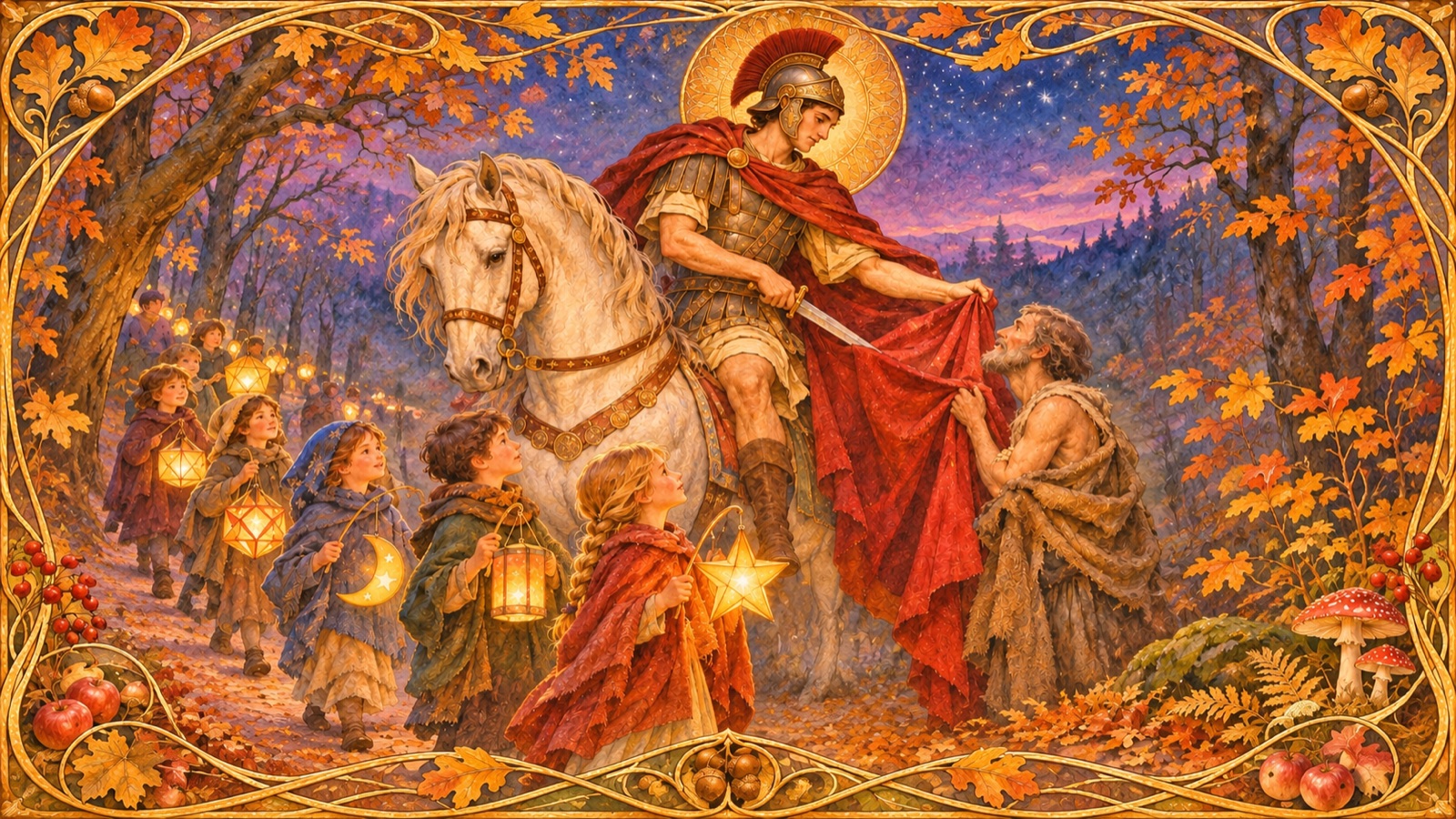
A small festival
This afternoon, at the Waldorf school where my daughters study, the Lantern Festival is being held. Saint Martin of Tours' day is November 11, but many Waldorf schools move the ceremony up a few days. It is so simple that anyone unfamiliar with it might mistake it for a school outing.
The children spend weeks making paper lanterns. At dusk they go out walking with them, accompanied by teachers and families, and the light barely reaches far enough to show the path, the tree trunks and the face of the person next to you. In Europe, where the custom was born, the festival falls when the days grow short and the countryside begins to put itself away for winter. The lantern stands for the light a person keeps inside when there is none left outside.
I have gone other years. This year I see it differently.
I have spent twenty-five years in large organizations. I have led teams, built technology and AI infrastructure projects, and seen up close what people do when power and money are at stake. From all that I draw an uncomfortable conclusion: there are virtues our age has begun to treat as defects. Loyalty. Temperance. A sense of duty. Honorability. We still cite them in annual reports and year-end speeches, and they vanish the day they start to cost something.
There is also a contradiction I know firsthand. I work with artificial intelligence systems that reason about complex problems, answer in several languages and solve in minutes what used to take years of craft. We have never had so much technical intelligence within reach. I do not see our conduct improving in the same proportion. We know how to build ever better machines. I doubt we are forming better human beings.
That is why this afternoon I am thinking about a Roman soldier of the fourth century.
The soldier and the cloak
Martin (Martinus) was born in Savaria, in the Roman province of Pannonia, in what is now Hungary. He was the son of a military tribune and joined the Roman army very young. Years later he laid down his arms, founded a monastery in Gaul and ended up as bishop of Tours. But what made him a symbol happened earlier, while he still wore the uniform.
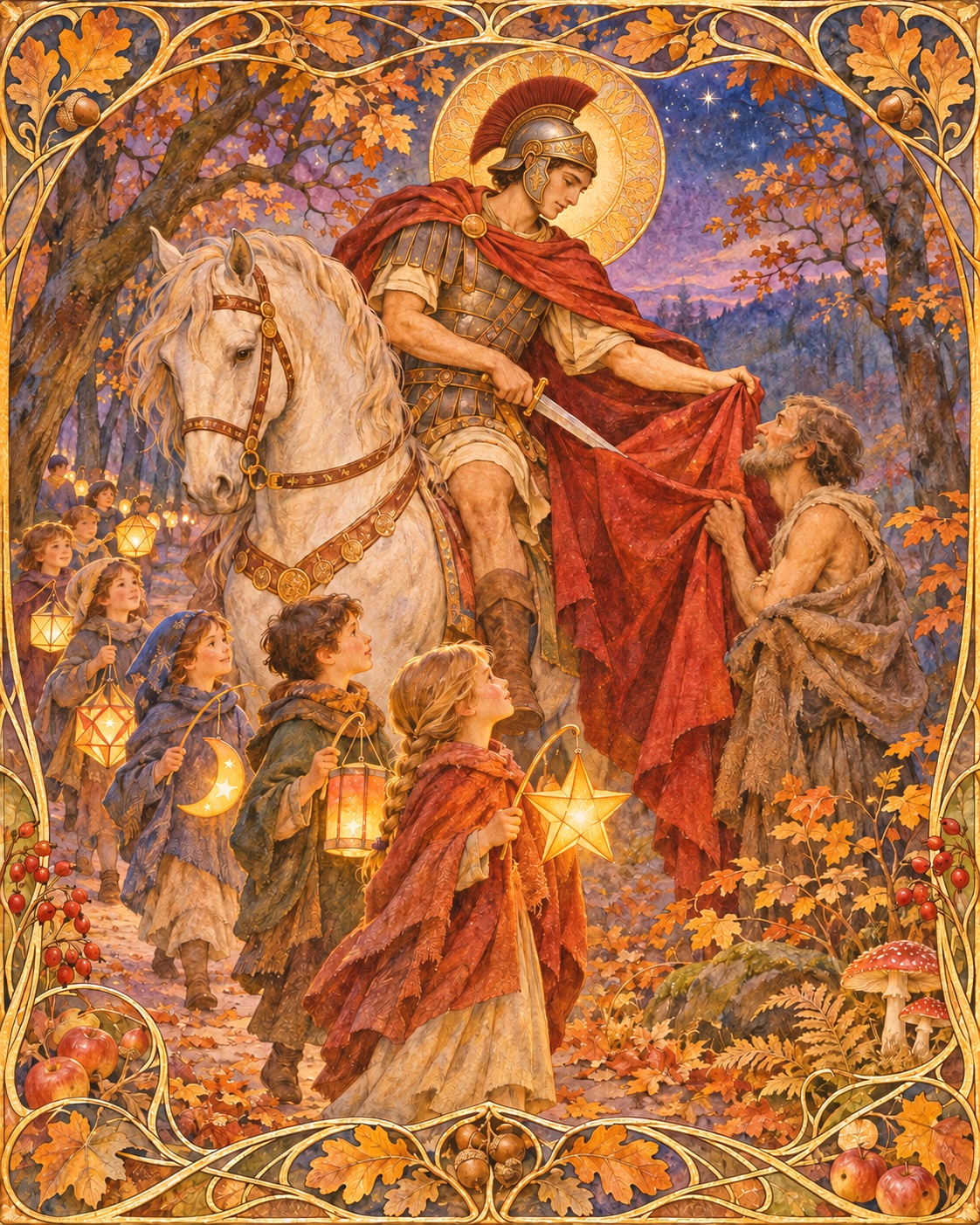
Sulpicius Severus, who knew him in life and wrote his biography, tells that during a winter so harsh that many people died of cold, at the gate of the city of Amiens, Martin found a nearly naked man begging from passersby. No one stopped. Martin had already given away everything else he owned, so all he had left was his horse, his weapons and his military cloak. He drew his sword, cut the cloak in two and gave half to the man. Severus adds a detail that is almost never repeated: some of those present laughed at him, because the soldier looked ridiculous in half a cloak.
What interests me about that man is what he had. He belonged to an institution built on discipline, hierarchy and organized force. He carried weapons and held rank over a beggar. He could have walked on and no one would have judged him. He stopped, and used for sharing the same instrument he had been given for fighting.
He also kept the other half. Compassion did not require him to be left naked or to destroy himself. I find that an important detail, because we tend to confuse goodness with defenselessness. The weak do no harm because they cannot. The honorable man can, and understands that this capacity places obligations on him. That difference is what I understand by chivalry: an ethic of protection, far more than a manual of good manners.
In Mexico we know Saint Martin the Horseman. His image hangs in small shops, food stalls and workshops, sometimes next to a horseshoe or an aloe plant, and some people leave grass or alfalfa for the horse so that sales do not run dry. The saint who gave away half a cloak ended up as the patron of the counter. I do not say this mockingly: anyone who runs a small business knows that selling is surviving, and few understand the stress of variable income and fixed expenses. But it is worth remembering from time to time why he is painted with the sword over the cloak and not over the poor man.
What the Stoics thought
Martin was not a Stoic. His story belongs to the Christian tradition, and it would be false to attribute to him a doctrine he did not profess. Even so, his gesture has a great deal in common with the best of Roman Stoicism.
The school was born in Athens around 300 BCE, with Zeno of Citium, and in Rome it had three representatives who could not have been more different. Seneca was one of the richest men of his time and an adviser to Nero. Epictetus was born a slave. Marcus Aurelius ruled the most powerful empire in the West. All three asked themselves the same question: what makes a human life good?
The answer is still uncomfortable. Wealth, prestige, office and the approval of others were, for them, indifferent things: preferable in certain circumstances, incapable by themselves of making a life good. The only things that counted were the virtues, and they recognized four. Wisdom, to tell the true from the apparent. Justice, to fulfill what we owe others. Courage, to bear fear without betraying ourselves. Temperance, so that worldly appetites do not end up governing us.
None of these four appears on a corporate business card. A chief executive may have none, and a maintenance worker may have all of them. Success is a circumstance; honorability is a decision. Our age measures the first with obsessive precision. For the second it has lost the instruments.
When organizations reward what they condemn
I know the value of discipline, of answering for results and of making decisions that affect people. Of putting the organization's interests above the family's. I have been part of the corporate world. A company has to sell, compete and sometimes cut. Profitability is a legitimate condition of its existence, and I do not expect it to function as a charity.
What I question is something else: that the organization's interest becomes sufficient justification for any conduct, however vile or obscene.
The degradation begins when a company stops distinguishing between what is convenient and what is right. From then on loyalty becomes negotiable, a given word expires, and trust built over years can be liquidated in a single conversation. Betrayal changes its name and is called pragmatism, or business intelligence. Displacing someone through intrigue is called “restructuring.” Appropriating someone else's work is called “showing leadership.” Staying silent in the face of injustice is called “prudence.” Acting with disloyalty and treachery is “being quite the artist.”
I have worked with executives who exercise their authority with an admirable sense of responsibility, who inspire loyalty and admiration. I have also seen enough of the opposite to know the problem is not anecdotal. An institution begins to rot when it systematically rewards the conduct its own code of ethics condemns. There have always been disloyal people. What is serious is when disloyalty pays, when lack of scruples speeds up promotions and when whoever keeps their principles ends up seen as an obstacle.
No company needs to write that lesson in a manual. Employees learn it on their own: it is enough to feign honor while it is convenient, and to reward treachery with a promotion and a nice office. That is the form of corruption that worries me most, because it uses the vocabulary of virtue to cover vice.
What Stoicism does not ask
There is a superficial interpretation of Stoicism that reduces it to enduring in silence. On that reading, the Stoic should remain impassive before betrayal and resign himself to abuse. I do not share it.
Epictetus taught us to separate what depends on us from what does not. We do not govern the decisions or the conscience of others. We do govern our own judgments and our own acts. That distinction was never a renunciation of justice, which was one of the four virtues. Marcus Aurelius, who had an empire in his charge, left it written in his Meditations: what is not good for the hive is not good for the bee.
One can defend a right without becoming vengeful. One can set a limit without losing courtesy, and leave a rotten professional relationship without copying its methods. Feeling indignation is allowed. Stoicism does not demand a lack of emotion; it demands that an understandable emotion not end up justifying conduct one would condemn in oneself.
It has cost me to learn this. When someone betrays our trust, the first impulse is to hit back, to show that we too have resources, influence or information. It is a strong temptation because it promises to restore a balance. The question I ask myself in those moments is what kind of person I would become if I did.
We cannot always prevent an injustice or guarantee that whoever commits it will pay for it. We can prevent that experience from becoming the center of our life. I am not willing to let other people's lack of honor force me to give up my own.
Pornocracy (government by prostitutes)
A few weeks ago I began writing a new book with that title. It is still far from finished, but the word has been with me for some time and this festival obliges me to explain it.
The term has a history. It was used to name the years of the tenth century when Theodora and her daughter Marozia, two women of the Roman nobility, made and unmade popes. I use it in another sense: an order in which display replaces merit, provocation displaces knowledge, and the capacity to attract attention is confused with having value. Sex is only its most visible showcase, and it is not always on a screen. It can also be found in some executive offices, where closeness to whoever is in charge is confused with merit and favors are traded for promotions.
The book began as a reflection on OnlyFans, on narco-culture, on the children who today would rather be hitmen than astronauts, and on the girls who would rather have an OnlyFans page than a university degree. Very soon it went somewhere else. The most damaging vulgarity I have seen did not shout or undress. It wore a tailored suit, had a master's degree, spoke of diversity and ethics in the auditorium and shouted at its assistant in the hallway. It is the vulgarity of the one who demands absolute loyalty and feels free not to return it. Of the one who displays impunity as proof of intelligence.
That vulgarity has nothing to do with social origin, manner of speaking or way of dressing. It has to do with poverty of character.
There has always been ambition, vanity and corruption, and there is no past in which all men behaved honorably. What would be new is for our institutions to stop seeing these behaviors as defects and begin treating them as competencies. Then degradation stops being a private matter and becomes an incentive system. Anyone who has designed an annual bonus scheme knows how that ends: people end up doing what they are paid to do.
The paradox of artificial intelligence
It pains me that this is happening at one of the moments of greatest technological potential we have had.
My work consists of building conversational agents and generative avatars for media, banking, retail and government organizations. Twenty-eight years ago, in my first novel, I imagined a good part of what I build today. Then it was science fiction. Now these are everyday tools, and I have taken part in projects where they helped preserve cultural heritage that was being lost. I am not an enemy of artificial intelligence (quite the opposite). I believe we are facing a change on the scale of the printing press or electricity.
That is why I worry about the moral direction we give it. The same tool that should free up time, open up education and speed up medicine helps a corrupt organization surveil better, and helps an unscrupulous executive wrap in a data analysis a decision already made out of convenience. We can produce millions of words without understanding a single idea. We can generate a perfect face with no one behind it to answer for what it says.
Artificial intelligence amplifies human capabilities, and human capabilities are not necessarily virtuous. In an organization with solid principles it strengthens the institution. In one dominated by opportunism it multiplies opportunism by orders of magnitude.
Hence my insistence on governance in all my talks. Controlling technical risks and protecting data is the minimum. The underlying question is who decides, by what criteria, and who answers to the people affected. The real danger is not that machines learn to think like us. It is that we stop thinking morally while we build them.
A pornocracy assisted by artificial intelligence would be a terrible contradiction: the most sophisticated tools in our history placed at the service of our lowest impulses.
Four lanterns
I cannot keep my daughters from knowing the dark. Sooner or later they will meet lies, manipulation and disloyalty. They will discover that some people are recognized for reasons that have nothing to do with merit, and that behaving well is not always rewarded.
I do not want to raise them believing the world is just by nature. I prefer that they understand justice is human work, because it does not appear on its own. Nor do I want to turn their education into training for suspicion and resistance. Whoever distrusts everyone loses the chance to build real bonds, and that is also a defeat.
I think of four lanterns.
The first is knowledge. Whoever knows history recognizes that many behaviors presented today as new are old ambitions in different clothes. Whoever understands how institutions work can tell when a rule protects and when it subjugates. My daughters will grow up surrounded by images that never happened, cloned voices and flawless texts that may be false from beginning to end. They will need to ask where each thing comes from, who benefits and what evidence supports it. And they will need something harder: to distrust themselves as well. An expert can act in bad faith, and an artificial intelligence can give an answer that is perfectly worded and completely wrong. I want them to know how to use technology and not hand their judgment over to a screen, an institution or anyone who demands obedience without giving reasons.
The second is honor. The word has aged badly. It is confused with pride or touchiness, and for centuries it was used to justify duels and crimes. That is not the one that interests me. I mean keeping one's word, acknowledging a debt, answering for one's own mistakes and not claiming others' merits, above all when no one is watching. And never using another person's vulnerability as a business opportunity. Loyalty belongs here, but not as blind obedience (a mistake of mine once): going along with an injustice because someone close commits it is complicity. Sometimes honor consists of staying, and sometimes of leaving in time.
The third is freedom. For Epictetus, the most important kind had nothing to do with chains. A man can hold an enormous office and live as a slave to the fear of losing it, or have a fortune and refuse to share it with his loved ones. But inner freedom is not enough. Economic autonomy, education and knowledge of one's own rights are also needed. A free person can reject an unjust proposal because they have somewhere to go. That is why it is not enough for me that my daughters be good people. I need them to be competent and able to support themselves, so that their principles do not leave them defenseless against those who have none.
The fourth is kindness, the virtue we confuse most. We tend to call good the person who never contradicts and accepts any demand so as not to cause discomfort. Often that is just someone afraid of defending themselves. Real kindness takes the strength to attend to a suffering that brings us nothing, and it takes judgment, because helping is not allowing abuse or creating dependence. Saint Martin shared his cloak. He did not hand his sword to the first stranger or give up his capacity to act. He was generous because he saw a real need. I hope they learn to help those who need it and to recognize those who only want to take advantage.
Whoever holds power over others
Martin's story also speaks about leadership. A teacher before students, a doctor before a patient, an officer before troops, a director before a team: in every one of these there is an asymmetry of power, and that asymmetry can serve to protect or to exploit. The hierarchy is the same in both cases. What changes is the character of the person at the top.
I have known people who understand a leadership post as a personal prize, a license to demand privileges and dispose of other people's work as if it were their own. For them, the company's resources are an extension of their home, and that includes the employees and the employees' time. So a subordinate ends up running personal errands for the boss's family, even on weekends. No one dares refuse, because whoever asks for the favor also decides who keeps their job. It is a miserable idea of command. To lead means to answer for decisions that affect the lives of people who have children, debts and plans. It does not guarantee that everyone comes out ahead. It obliges you to make the necessary decisions without adding cruelty or deceit to them. Authority does not reduce moral responsibility. It increases it.
At home the same rule applies. I will not always be able to walk ahead of my daughters removing stones. The day will come when they decide alone, make mistakes and pay consequences I cannot spare them. My job is to prepare them for that day.
I also want them to understand that strength is not the property of men, although we men have a particular obligation to examine how we use it. The chivalry I want to pass on does not consist of seeing women as weak or of reserving for ourselves a monopoly on protection. It is a discipline of character: not abusing force, not abandoning those who depend on you, and not confusing authority with moral superiority.
Not becoming what you despise
I do not write this from a philosophical serenity I lack. I know anger, wounded pride and the urge to pay back in the same coin. There are moments in professional life that test convictions one thought were firm. It is precisely there, and not when everything goes well, that the Stoics are of use. That is why I prefer them. Stoicism does not ask me to turn the other cheek. It asks me to take charge of what is mine, judge coldly what happened and act accordingly, without letting the grievance decide for me.
Resentment is a form of dependence. We remain tied to whoever hurt us because we organize around that hurt what we think and what we decide. Revenge promises to free us and usually prolongs the bond.
I am not proposing impunity or forgetting by decree. There are injustices that must be reported through the appropriate channels. I maintain something more modest: defending a right does not oblige us to adopt the vices of whoever violated it. One can remember without living a prisoner of the past, and one can stop trusting certain people without ceasing to trust humanity.
If a betrayal convinces us that loyalty is good for nothing, the damage ends up greater than the episode that caused it. We would have handed to someone else the decision about what kind of person we are.
When night falls
This afternoon, as they walk with their lanterns, most of the children will be thinking about the lights, the songs and the thrill of being outside at night with their classmates. That is fine. Childhood does not have to carry the miseries of adults. Understanding what we are trying to hand on to them is our job.
A paper lantern does not end the corruption or the vulgarity of an age. It can keep those behaviors from becoming the principles on which our children build their lives.
I would like my daughters to live in a world where knowledge is worth more than display, where leaders are recognized as just and not for their capacity to impose themselves, and where artificial intelligence works for people's freedom. A world where catedrocracy, rule by the lectern and by those who know, were a familiar word and not an almost esoteric term. I do not know whether we will see it. I know it will not arrive on its own just because we have better technologies. We will have to form people able to use them with judgment, give back dignity to a pledged word, and teach that force without justice ends in brutality.
Martin's story fits in a few things. A soldier before a defenseless man. A sword that could wound and ended up serving. A scarlet cloak that was cut in two to give shelter. A horse that was then a sign of rank and over the centuries became an emblem of honor. And a decision. Seventeen centuries later it still moves us because no institution, no office and no machine can make that decision for us: to act with kindness when we have the power to do the opposite.
To my daughters I cannot promise a world without darkness. This afternoon they get to watch their classmates fight it with a paper lantern made with their own hands. The metaphor could not be more tender or more fragile. What it takes to keep it burning they will learn from what they see me and the other parents do.
Saint Martin carried a sword, armor and a horse. We remember him for sharing his cloak.
— Oswaldo Alejandro Aguilar Castro
"Creating possible universes."