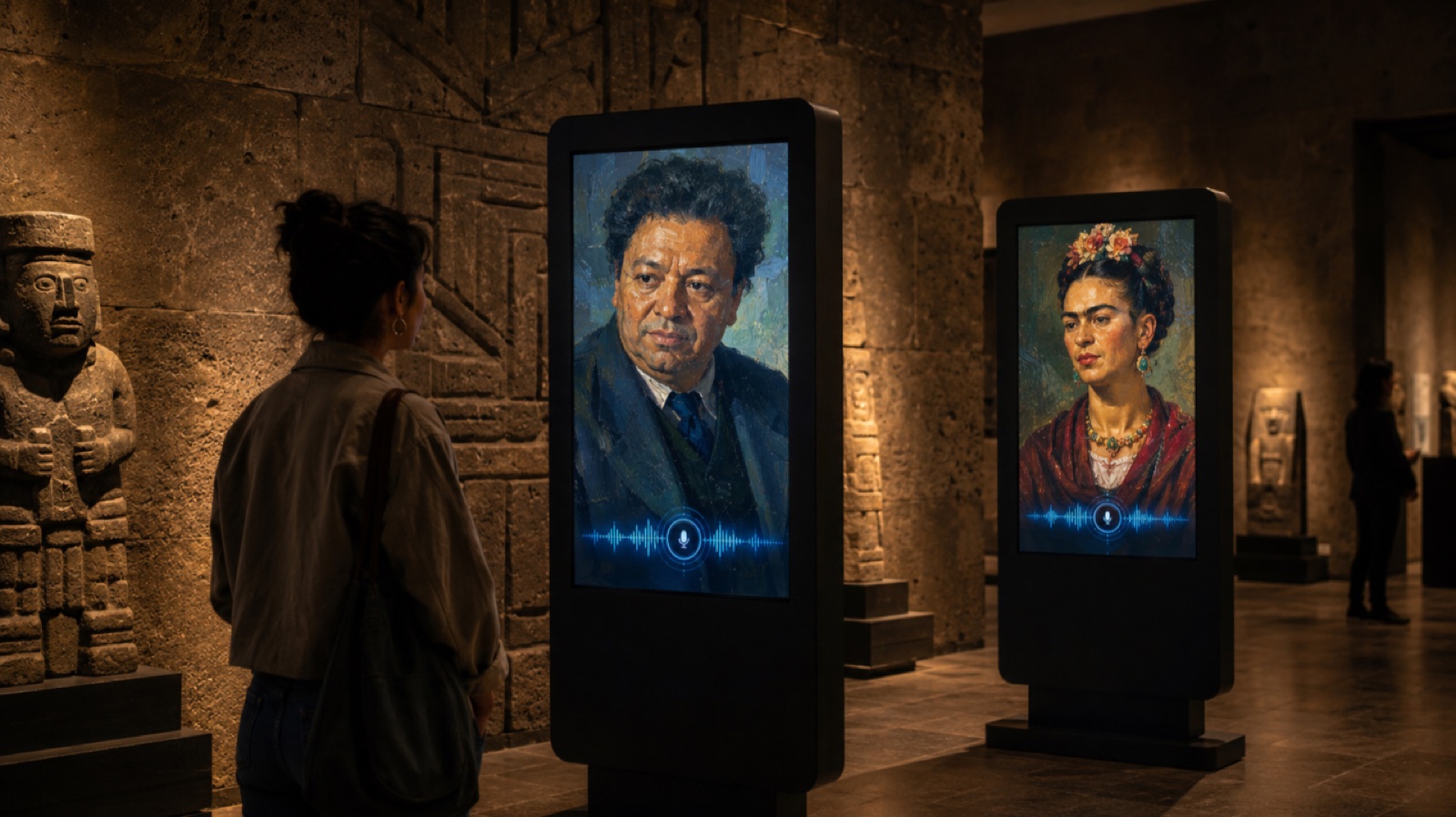
At Museo Anahuacalli, an eight-year-old girl walked up to the totem where Diego Rivera answers questions and asked the only one that came to mind: "Who was Frida?"
And Diego answered:
"In 1929 I fell in love with Frida Kahlo, the great painter with whom I lived my most intense relationship… She, my beloved Frida, was the single most important event of my life — the woman who managed to turn the most heartbreaking poetry into canvas."
That answer took six months to exist. And very little of those six months was engineering.
The project, in numbers
| Metric | Figure |
|---|---|
| Duration | 6 months — September 2025 to March 2026 |
| Museums | 2 — Anahuacalli (Diego Rivera) and Casa Azul (Frida Kahlo) |
| Curated answers | 80 — 40 per avatar, validated by each site's directorship |
| Audiovisual clips | ~140 — produced as a derivative work of the pictorial collection |
| Autonomous totems | 2 — local compute, offline except for the monthly report |
| Interactions | 6,240+ in the first three weeks of public operation |
| Conversations stored | 0 — session held in volatile memory, destroyed on close |
| Hallucinations detected | 0 — closed domain over a validated corpus |
| Ethical incidents | 0 — at the close of the first operating period |
The problem was never building an avatar
Worth stating up front what was already solved by September 2025. Generating an image, animating it, synthesizing a voice, wiring a retrieval engine over a corpus, sustaining a conversational turn — those were capabilities any reasonably funded team could buy. Building something that talked on screen was the easy part.
The hard question was different: with what authority can an AI system speak in the first person as Diego Rivera?
Everything else follows from that. What it can say. What stays out of bounds. Who decides what counts as historically accurate. Whether it can improvise. Whether it can use his face. Whether it can use his voice. Where a recreation ends and an impersonation begins. And who answers when the system gets it wrong. None of those questions gets resolved by writing code — and all of them have to be resolved before a line of it is written.
What we built
Between September 2025 and March 2026, the team at Grupo Fórmula's AI unit, designed, produced and installed the first conversational avatar of a historical figure operating inside Mexican museums: Diego Rivera at the Anahuacalli, his temple to mestizaje, and a sister piece featuring Frida Kahlo at the Casa Azul. Both sites are held in trust by the Museo Diego Rivera y Frida Kahlo Trust at Banco de México, and both draw Mexico's largest cultural audiences: the Casa Azul sees roughly 25,000 visitors a month, and the Anahuacalli holds nearly 2,000 pieces of the pre-Columbian collection Rivera spent his life assembling.
Eighty curated answers, forty per avatar. About 140 audiovisual clips. Two totems that run without depending on a connection. Zero visitor data stored. Curatorial authorization sat with the museum end to end: each site's directorship approved every answer before it entered the system.
I was the project's executive owner. And the core lesson doesn't fit on a spec sheet: an AI architect designs the boundaries the system is allowed to exist within before designing the system itself.
The four boundaries for recreating a historical identity
Every historical avatar operates across several boundaries at once, and treating them as a single decision is the most common conceptual mistake in projects like this. For Diego and Frida there were four, and each one offered a higher-apparent-capability option and a lower-risk one. We chose the lower-risk option all four times.
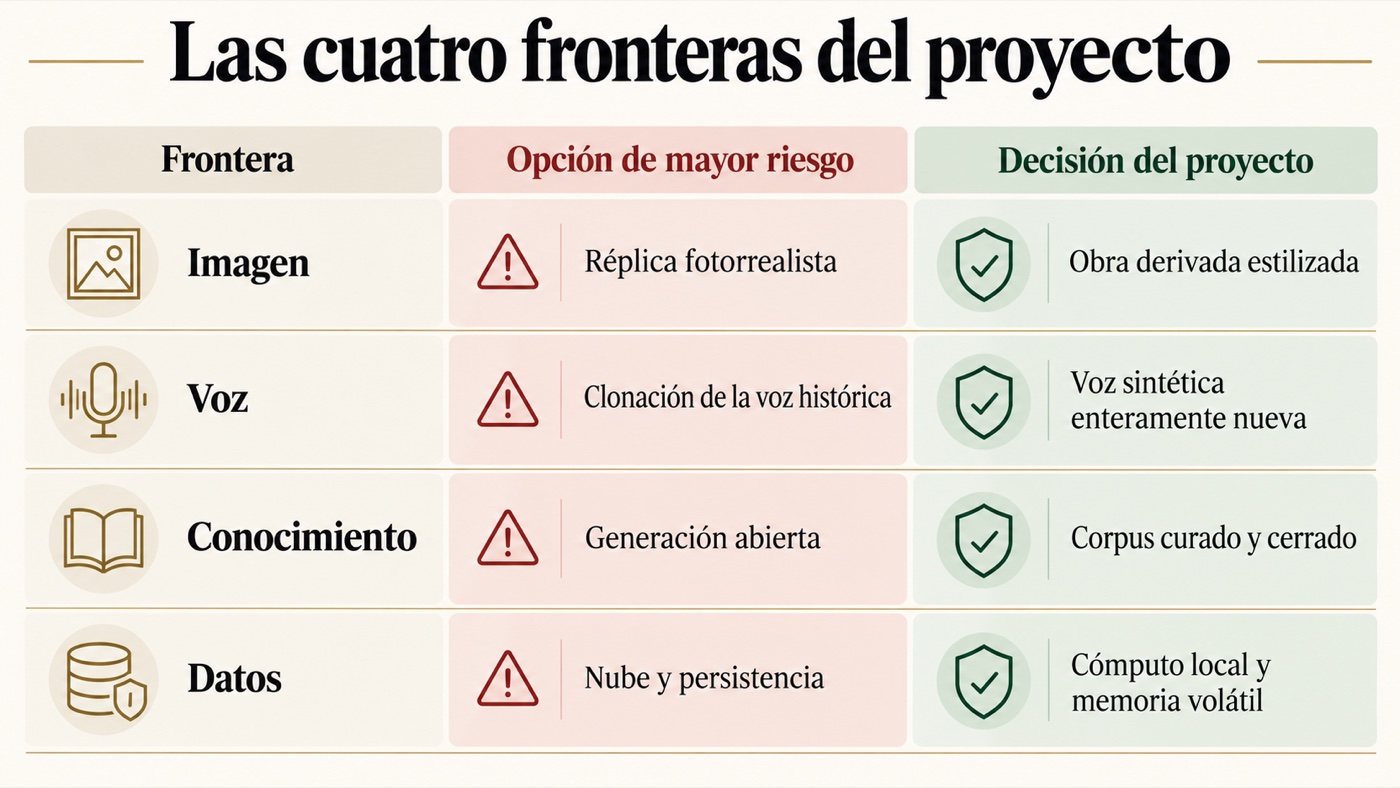
| Boundary | Higher-risk option | Project decision |
|---|---|---|
| Image | Photorealistic replica | Stylized derivative work |
| Voice | Cloning the historical voice | An entirely new synthetic voice |
| Knowledge | Open-ended generation | Curated, closed corpus |
| Data | Cloud and persistence | Local compute, volatile memory |
Image. We chose irreversible stylization: an artistic-cultural derivative work, built from the paintings in the collection itself — not a reproduction. The avatar evokes the character's aesthetic without claiming his actual face.
Voice. We chose creation. Entirely new, synthesized voices, with no reference to any historical recording. There's no possible audio impersonation because there's no original left to impersonate.
Content. We chose to close it. The avatar retrieves answers previously validated by curators through a retrieval engine that runs on the totem itself, and when a question falls outside the corpus it acknowledges the limit politely. That's the hardest decision to defend in front of a client, because an open chatbot always looks smarter in a demo.
Data. Compute at the edge. Each totem is an autonomous node that runs offline most of the time: the session lives in volatile memory and is destroyed on close, and no visitor conversation ever leaves the museum. The system supports a connected mode used for exactly one thing: pulling the anonymous aggregate of what people asked — no conversations, no identities — for the museum's monthly interaction report. That's the entire telemetry footprint. 2026 is full of products offering per-visitor behavioral dashboards; we rejected that path on purpose. A museum is a space of intimate connection between a person and their heritage, and turning that into a sellable data stream degrades it.
How the system actually worked
The full path of a question, from the moment a visitor speaks to the moment Diego answers, happens entirely inside the cabinet installed in the gallery:
Visitor → Spoken question → Recognition and interpretation → Search over the curated corpus → Previously validated answer → Audiovisual clip selection → Diego answers → Session destroyed
What matters about that flow is where the human sits — and it's in the four places that count. Curators validate the corpus and every answer. The creative team builds the representation. The AI team builds the system. And the museum holds final authority: it ships when the museum approves it, not when the vendor declares it done. In a heritage project, that asymmetry should always favor the custodian of the legacy.
Diego's training catalog grew to 471 phrasings grouped into 38 topics, because every question was loaded with its semantic variants. "Who was Frida," "who is Frida," "what did Frida mean to you" and "did you love Frida" are four ways of asking the same thing, and all four had to land on the same approved answer. That invisible work is the difference between a system that converses and one that forces the visitor to guess the magic words.
When a hallucination stops being a technical bug
A wrong answer from a general-purpose assistant is an annoyance. The user notices, corrects it or ignores it, and the cost spreads across millions of anonymous interactions.
When a system speaks in the first person as a historical figure, inside the institution that is the custodian of his legacy, the nature of the error changes completely. A hallucination about Diego Rivera's life isn't a software bug. It's a historical falsification, issued under the seal of the very museum that exists to prevent one.
At that point the conversation stops being about accuracy and becomes about institutional authority. The technical probability of getting it wrong and the institutional risk of getting it wrong are two different quantities, and the second one doesn't get managed by lowering the model's temperature. The system had to make hallucination impossible, not merely unlikely. That's why the engine retrieves instead of generating: the guarantee doesn't rest on the model's statistics but on the architecture around it.
The day the project landed on its feet
The surprise that no risk matrix had flagged arrived halfway through. The Trust owned the museum's artworks. It did not own the faces of the people who painted them.
That restriction forced us to rebuild the entire visual foundation of both avatars from the paintings in the collection itself. In a project meeting it sounds like a minor adjustment. In practice it meant weeks of iteration to get a face derived from painted brushwork to hold expressiveness, stay consistent from one clip to the next, and sustain a conversation without breaking the illusion — with a team already stretched thin and an institutional calendar that never moved by a single day.
And something we hadn't anticipated happened. That legal problem quietly solved the most serious aesthetic objection we'd heard from the museum community. A Diego derived from painted brushwork read, to the people who know Mexican art best, less like an unsettling replica and more like a legitimate work. The legal constraint produced a better solution than the one we would have chosen on our own.
I've carried a rule out of that since, and I treat it as method now: you don't manage a serious critic — you turn them into a product spec. The curator who spots the one detail nobody else caught is the best quality control the project will ever get, and it doesn't cost a peso.
Six months to build one conversation
September 2025 — Project kickoff under the Trust's contract.
Undated phases — Research and concept design. Legal and curatorial definition. Visual construction. Corpus and answers. Technology development. Audiovisual production. Integration.
November 6, 2025 — On-site QA, Anahuacalli. Minor notes; the avatar operational after fine-tuning.
November 12, 2025 — On-site QA, Casa Azul. Significant notes: the site's directorship requested several rounds of adjustment to visual expression, tone of voice and curatorial fidelity, which multiplied that avatar's video production.
March 23, 2026 — Formal delivery of both systems.
April 2026 — Thirty days of silence: live operation with real visitors, no press, no social media, no announcement.
May 16–17, 2026 — Public unveiling as part of International Museum Day.
The two November QA sessions explain much of the project. One system, two museums, two curatorial directorships, two opposite outcomes: one passed with minor tweaks, the other opened a long round of corrections. The technology was identical in both cases; what changed was how much each institution demanded of the representation of its own historical figure.
The three clocks of a cultural AI project
A project like this runs on a technical plane, a creative plane and an institutional plane, and each one moves at its own pace.
The technology clock marks what we're already capable of building. The creative clock marks what we can represent convincingly. The institutional clock marks what we're authorized and prepared to do. All three run at different speeds, and the project can only move as fast as the slowest one.
The usual temptation is to subordinate the creative to the technical, because technology sets calendars, or to subordinate the technical to the creative, because the avatar is the visible output. Both subordinations produce fragile projects. We organized the team deliberately as modular, with formal interfaces between four disciplines: direction and strategy, agentic AI development, creative production, and logistics and installation. Each with a named lead, an explicit scope, and a defined handoff to the others. None blocked another for six months. That — not the tool stack — was the real engineering achievement.
The framework travels well outside a museum. In banking, media, government, healthcare and education, the same structure shows up: what the technology allows, what the organization actually knows how to represent, and what the institution is authorized to stand behind. Confusing the first clock with the other two is the most common way to announce an AI project that later can't ship.
The lesson no governance manual covers
There was a point where a voice engine that wouldn't stabilize, microphone failures sabotaging any live demo, and part of the museum community openly talking about rejecting the project all converged at once. Against that backdrop, the hardest pressure came from inside: someone on the team decided that was the moment to dispute who had the authority to make a call — not the call itself.
Pressure and proximity to a project can convince anyone that execution equals authority. Neither AI nor the flattest organizational culture eliminates that risk. Only the judgment of whoever is leading does.
A team that renegotiates its own chain of command mid-crisis is letting go of the wheel on the worst curve in the road. Hierarchy, in those moments, is the condition that makes trust possible afterward.
What we decided not to build
The part of the project I'm proudest of is a list of available capabilities we left out. We did not clone a voice. We did not build a photorealistic replica. We did not allow open-ended generation. We did not store conversations. We did not send anything to the cloud. We did not turn the visitor into a data source.
Every one of those six decisions cost something. A cloned voice would have sounded closer to the man. A photorealistic face impresses more on the first visit. An open model answers any question. A per-visitor analytics dashboard sells itself. We gave up all of it, and the system came out better for it.
Architecture is also deciding which available capability should not be used. That sentence sounds obvious on paper and is extraordinarily hard to hold to in front of a demo where the competitor is showing off more features than you are.
Silence as strategy
We delivered on March 23, 2026, and kept thirty days of absolute silence: no press, no social media, no announcement. The system ran on the gallery floor, with real visitors, without a single public statement.
It was a design decision, and it had four reasons.
The first is that an installed system behaves differently from a tested one. No QA session reproduces the noise of a full gallery, real accents, the questions nobody thought to write, kids shouting into the microphone. We needed to see that before inviting a camera in.
The second is risk sequencing. If the avatar was going to fail, better it failed in front of twenty visitors than in front of the national press gathered to watch it. An early failure with no audience is a project incident; the same failure under spotlights becomes the headline that defines the project for years.
The third is evidence. Arriving at the public unveiling with weeks of accumulated operation let us say something no demo can claim: this has been running in here for a month already.
The fourth is legitimacy with the museum community itself. Part of that world was hoping we'd get this wrong. An avatar that quietly works for weeks convinces that audience far more than any executive presentation does.
In high-exposure AI systems, the technical launch and the reputational launch don't have to happen on the same day. Separating them is a governance decision, and it deserves to be written into the contract alongside the delivery dates.
In the first three weeks of public operation, the system logged more than 6,240 interactions. Zero data stored. Zero hallucinations detected. Zero ethical incidents. In a heritage project, zero is always the number that matters most: success is measured by how little gets compromised.
The project, from the institution's side
Museo Anahuacalli publicly unveiled the initiative as part of International Museum Day 2026, inside a broader program to activate its digital ecosystem. That version is worth reading, because it's the custodian's account, not the vendor's — a claim about yourself is worth little without the outside evidence that backs it.
Read Museo Anahuacalli's official announcement → (in Spanish)
What I'd do differently today
Four things, having watched the system run.
I'd build curatorial validation into corpus design, not bolt it on at the end. We treated it as an approval stage when it should have been a construction stage; the cost of that sequencing was paid in full during the Casa Azul adjustment rounds.
I'd define the sonic identity during design, not production. The voice ended up being the component that stabilized latest, and it hit the project's mid-point crisis unresolved. A voice is a character decision, not a technical deliverable.
I'd contract corpus maintenance as an ongoing service from day one. A museum with 25,000 visitors a month generates new questions every month, and a frozen corpus ages in full view of the public.
And I'd write the silence period into the contract. We held it by judgment, and judgment doesn't survive a change of counterpart. What isn't in the contract depends on the same people staying in the same seats.
Back to the girl
I think often about that eight-year-old's question. She didn't ask about muralism, or the Anahuacalli, or pre-Hispanic cosmology. She asked about the person Diego loved.
That's exactly what a silent museum can't offer, and exactly what an open chatbot shouldn't dare to improvise. Between those two extremes — the museum that informs without conversing, and the machine that converses without answering for anything — is the territory we work in.
Recreating a genius isn't resurrecting him. It's building a new way to listen to him, inside the ethical limits his legacy deserves.
The technology to do this is already available anywhere in the world. The judgment to do it well is not. That's where Mexico still has something to prove — and where we chose to start.
— Oswaldo Alejandro Aguilar Castro
"Creating possible universes."
Sources