There's a question I ask when a company tells me it's already "using artificial intelligence": who has the authority to stop it? Not who bought the platform, not who understands the model best, not who has access to the corporate account, and not who wrote the code. Who has the authority to say a use case doesn't move to production because the risk outweighs the benefit. The answer usually takes a while to arrive, and that delay is the diagnosis.
When I published the first version of this piece, in March 2026, my concern was that many organizations were adopting artificial intelligence without a formal policy. Today we can say that in Mexico, roughly 6 out of 10 organizations still don't have a fully defined and applied AI governance framework; across Latin America, the absence of formal policies also remains significant, though published figures range from around 22% to over 90% depending on the sample and what exactly was measured.
No criteria for what information could be used, which tools were authorized, what a human had to review, or who was accountable when something went wrong. A few months later I would revise one part of that thesis. A policy is necessary, and by itself it changes almost nothing. The real bottleneck isn't writing the policy. It's governing it.
A Mexican study by Accenture, IPADE Business School and the Consejo de Empresas Globales reports:
| AI governance status | Share of organizations in Mexico |
|---|---|
| Has a formal, applied governance framework | 36.4% |
| Framework still under development | 52.3% |
| No defined, applied framework | 63.6% |
Source: Accenture, IPADE Business School and Consejo de Empresas Globales.
An important nuance: that 63.6% doesn't mean these organizations have no initiatives whatsoever. More than half are "in development," so it isn't accurate to equate "no applied governance" with "no policy, committee, protocol or control at all."
Adoption is also outrunning institutionalization:
- 66% of large Mexican companies remain in pilots, isolated tests or structured experimentation with AI.
- Only 13.5% have successfully scaled it as an integrated part of the core business, per the report's coverage.
- In a separate measurement, 55% of Mexican companies surveyed report using AI on an ongoing basis.
- Banco de México found that 24.3% of national companies with more than 100 employees were using or planning to use AI within the next 12 months; among those using or planning to, 61.1% were still evaluating feasibility or running pilots.
Policy, governance and controls are not the same thing
The three words tend to blur together, and in practice it's worth keeping them separate. Policy states what principles the organization accepts, what uses it permits, what it restricts, and what it prohibits. Governance establishes who makes those decisions, who authorizes exceptions, who classifies risk, who supervises, who pays and who is accountable. Controls turn all of that into something verifiable.
A company can have an impeccable policy sitting in SharePoint and no governance at all — I know of at least one. If nobody knows who approves the development of a new agent, if a department uploads confidential information into a free ChatGPT session without review, if Marketing publishes AI-generated content with no traceability, or if HR "builds" a system to support hiring decisions without ever defining its limits, the document exists but the control is nowhere to be found.
At Grupo Fórmula, I was responsible for developing the corporate AI policy that the CEO later approved and that became the foundation of the group's Responsible AI framework. The important lesson came afterward: writing what should be done is relatively simple. Getting an organization to actually prove that it does it is a different discipline entirely.
Governance begins when someone has to decide
It's easy to talk about AI ethics when everyone agrees. Governance begins when they stop agreeing. Operations wants to launch. Technology says it can be done. Legal flags an exposure. InfoSec asks where the data will live. HR discovers the system could affect employees. Finance asks what it costs to maintain. And someone has to decide.
That someone can't always be IT, nor always Legal, and certainly not the vendor who sold the solution. One of the mistakes I see most often is treating AI governance as a purely technological problem. AI cuts across too many functions to live inside just one. A model can be technically sound and legally unworkable; it can be legally viable and reputationally disastrous; it can clear both tests and still make no economic sense. It can even work perfectly and still fail. That last one already happened to me.
When working isn't enough
The AI spokesperson project for Club América is probably the case that changed my thinking about governance the most. The project worked. Some of its Instagram videos reached between 1.2 and 2.4 million views, the technology did what it was supposed to do, and the audience was there. The backlash on social media ended up making it unsustainable.
The lesson was uncomfortable because it forced me to abandon an idea that's very comfortable if you come from a technology background: that a system which works and hits its metrics is a successful system.
Who is going to defend this decision when the friction arrives? That's governance too.
Reputational risk doesn't show up in a latency test, it isn't fixed by increasing model accuracy, and it doesn't disappear because a technical committee approved the architecture. A public-facing project needs enough institutional sponsorship to survive disagreement.
NAT was born before "AI governance" was an expression we used every day. It went live in 2023, went on to be the subject of an interview with the Reuters Institute, University of Oxford, and over time evolved into a permanent operation and into other AI-assisted production and distribution systems. Editorial control showed up long before the formal vocabulary did: some topics could be published and others required review, some errors forced a piece to be pulled, some editorial decisions a machine should never make. We formalized the principle afterward. At TVOAI News, automation handles a considerable part of the process, and final publication retains human verification.
Human oversight belongs wherever accountability shifts, and that distinction matters more than it seems. Putting a person in charge of reviewing every output of a low-risk system destroys much of the efficiency that justified automating it in the first place. Removing it where a decision affects reputation, money, rights or public information is irresponsible. The operational question is at what point in the process it stops being acceptable for the machine to act alone.
Risk changes with context
A conversational AI demo at a tech fair and a system deployed inside a financial institution can use similar technology and still not be the same project. In banking, privacy, identity, access, traceability and institutional compliance all show up. The deployments we ran in financial environments had to operate under exactly that kind of control: model risk management, privacy by design, identity and access management.
Which leads to something worth stating plainly: there is no single governance model for every AI case. There is a common framework, and the controls change with the risk. It's the same logic behind the international frameworks. The NIST AI Risk Management Framework is organized around four functions — govern, map, measure and manage — and treats governance as a function that runs across the entire lifecycle of the system. ISO/IEC 42001 takes that same logic into the management system: policies, processes and controls that must be established, maintained and continuously improved. Neither one is about filling out forms. Both are about administering decisions.
The conversational avatar of Diego Rivera at the Museo Anahuacalli took the problem into different territory altogether. What was at stake wasn't just technical accuracy, but a cultural legacy tied to what we understand today as Mexican identity. The challenge was enormous. The system couldn't "imagine" what Diego Rivera might have thought about a subject he never addressed, nor sacrifice historical rigor to produce a more entertaining conversation full of hallucinations. So the project reversed the usual order: curatorship first, technology second. The answers were built from institutional materials, validated by the museum, and only then incorporated into the system. Instead of allowing open real-time generation, the engine retrieves approved answers from within a curated corpus, and when a question falls outside that domain, the system recognizes the limit. That decision reduces the system's apparent capability and improves the product. That's often how governance works: the useful question stops being how many things AI can do, and becomes which ones it should.
Shadow AI grows without asking permission
There's another phenomenon I've learned to take much more seriously. An employee discovers a tool that lets them finish in twenty minutes something that used to take two hours. They start using it. Then they upload a presentation, then a contract, then a database. Nobody acted in bad faith, and that's precisely the problem: most shadow AI is born from people simply trying to work better.
Banning every external tool rarely solves the phenomenon; it just makes the use invisible. The answer needs understandable rules and institutional alternatives people actually prefer to use. If the authorized tool takes twenty steps and the unauthorized one solves the problem in two, the policy will lose. A mature organization removes the reasons that make shadow AI attractive, and sets clear limits where the risk demands it.
Governance frameworks fail when only the person who designed them understands them. An employee shouldn't have to read fifty pages of corporate policy to know whether they can run a results report through a generative AI tool. Which is why I've come to prefer a much simpler operational classification:
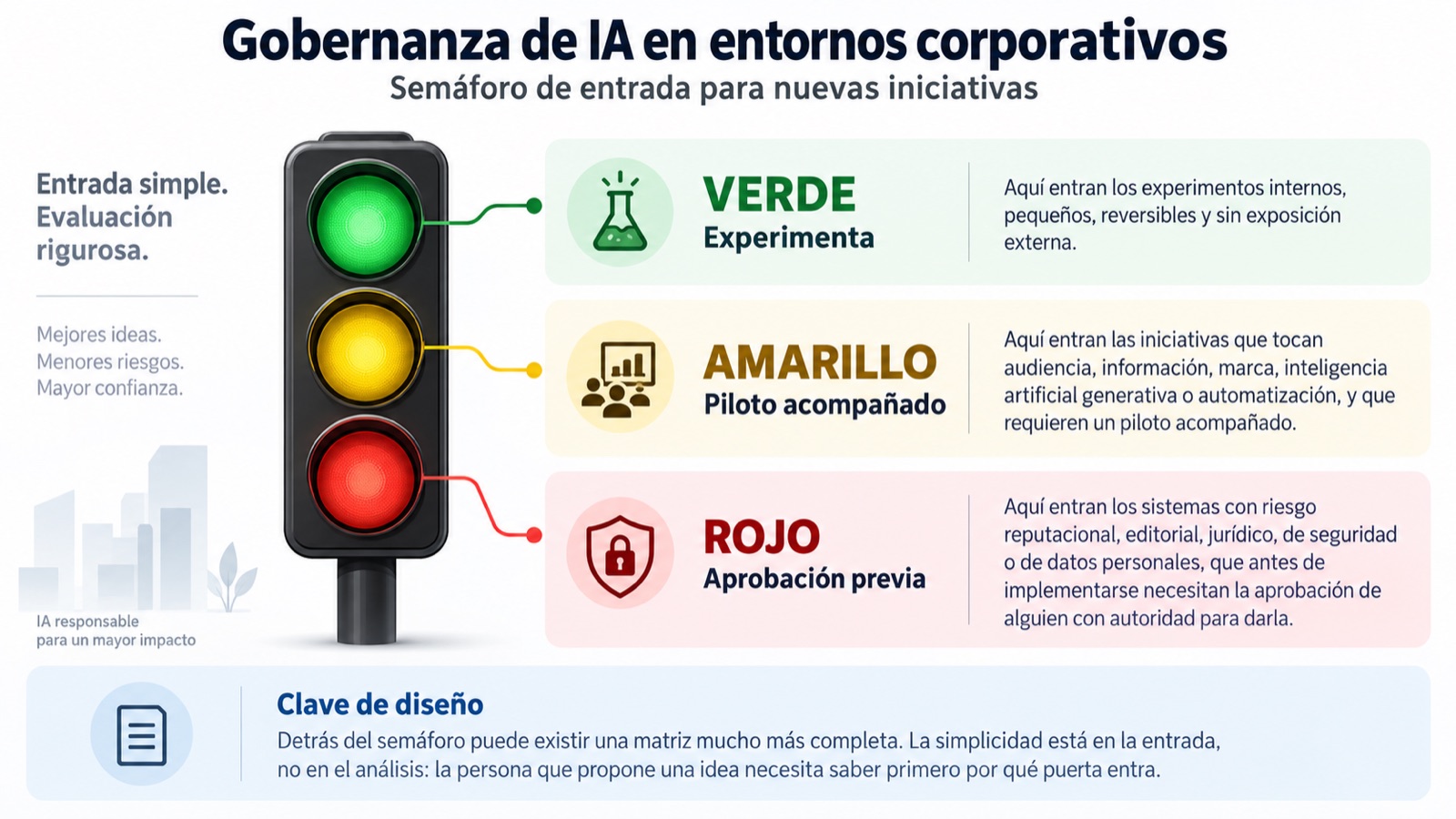
A far more complete risk matrix can live behind the traffic light. The simplicity belongs at the entry point, not in the analysis: the person proposing an idea just needs to know which door to walk through first.
A control that leaves no evidence is useless
This is probably the most important difference between an AI policy and an actual governance system. The policy can say that high-risk systems require human approval. The auditor will ask a different question: where's the evidence that it happened.
That's why controls need to produce traceability. For any system that matters, it should be possible to reconstruct who its business owner is, for what purpose it was authorized, what risk classification it received, where the data comes from and how it's handled, which vendor and which model are behind it, what prior assessment was done, who approved it, what tests were run, what versions exist, where human oversight was defined, what incidents occurred, what changed afterward, and when it's due for review. Not every project needs the same depth of documentation — demanding that would just be bureaucracy. But any system that matters needs to leave enough of a trail to reconstruct why it was authorized and under what conditions. The memory of a meeting doesn't do that.
Regulation stopped being a future conversation
For several years it was possible to talk about AI regulation as something that would eventually arrive. That time is over. As of August 2, 2026, new transparency obligations for certain AI systems began applying across the European Union: informing people when they're interacting with a machine, for instance, and requiring identification for certain AI-generated or manipulated content. The European Commission also began exercising new AI Act enforcement powers. Specific rules for systems classified as high-risk follow later timelines: December 2027 for certain Annex III uses and August 2028 for AI embedded in certain regulated products, following Europe's 2026 adjustments.
That calendar is preparation time. For a Latin American company that sells into Europe, uses global vendors, processes data belonging to citizens of different jurisdictions, or simply aspires to become a supplier to a multinational, governance can no longer be designed by looking only at local legislation. Standards are starting to travel with the client.
Who signs
Every governance architecture eventually comes down to two unglamorous questions: who signs, and who answers for it. The technical lead can certify that the architecture meets the required conditions. Security can assess the technological exposure. Legal can determine obligations and restrictions. Operations has to defend why the system should exist at all. But someone has to own the decision. For projects that matter, my preference today is a clearly identified business owner and an approval mechanism proportional to the risk — because when everyone is responsible, no one is.
The Chief AI Officer sits in an uncomfortable spot here. They're asked to police and to sell at the same time, and their real job is something else entirely: designing the system through which the organization can say yes, no, or not yet, using criteria that repeat. That's institutional architecture.
What I would do differently, starting from scratch
If I had to build the framework again tomorrow, I wouldn't start by writing the policy. I'd start with an inventory: what AI the organization already uses, who uses it, with what data, to make what decisions, what leaves the building, what happens automatically, which vendor can see company information, and what system can affect a person. But I would add a question I hadn't formulated with the same clarity back then: who is willing to use AI against the organization's own interests. Because the risk isn't always in the model. Sometimes it's in the person who turns a powerful tool into an instrument for their own agenda, even if doing so compromises their leader, exposes their team, or puts the business at risk. In those cases, governance also requires decisions about people: limiting access, removing responsibilities, or moving someone away from critical positions once they've shown they can't distinguish between personal initiative and institutional responsibility. The rules would come after. First you need to know what technology exists, who controls it, and — above all — whose hands it shouldn't be in.
I would define a simple risk classification and an owner for every use case from day one. I'd create a fast lane for low-risk experiments, because if everything needs a committee, the organization will simply learn to hide its experiments. I'd reserve multidisciplinary review for the cases that genuinely need it. I'd make human oversight an explicit design decision rather than a generic sentence tacked onto the end of a document. And I'd require every meaningful control to produce evidence.
I would also invest much earlier in culture, because I learned something the technical frameworks don't state clearly enough: a policy people fear produces secrecy, and a policy people understand produces better decisions. But culture also has to protect the organization from a less technical, sometimes more dangerous risk: the rise of self-styled "AI gurus" whose main skill is impressing the executive committee with a flawless presentation, and turning that novelty effect into real authority over decisions they aren't prepared to make. The ability to communicate matters, but it can't substitute for operational experience, risk judgment, business knowledge or accountability for consequences. A mature organization must prevent, at all costs, stagecraft turning into decision-making power. AI shouldn't end up in the hands of whoever sells it best internally — it belongs with whoever can prove they know how to govern it, operate it, and answer for it when something goes wrong.
Governing in order to build
For a long time we treated innovation and control as opposing forces. The right kind of control is what allows an organization to take risks that would otherwise be indefensible. A bank can use artificial intelligence because limits exist. A museum can let Diego Rivera "converse" with its visitors because a curatorial corpus exists that defines where his voice ends. That's governance: the architecture through which an institution turns uncertainty into decisions it can explain and defend to whoever demands an account of them.
I return to the question I opened with. When I ask a director who can stop the AI already running inside their company, the answer I'm looking for fits inside a name, a title and an email address. I almost never get it. I suspect that in most organizations, that signature will be assigned late — after the first incident forces a project to be canceled, or a settlement to be paid.
For a while longer, not signing is still going to cost less than signing.
— Oswaldo Alejandro Aguilar Castro
"Creating possible universes."
Sources